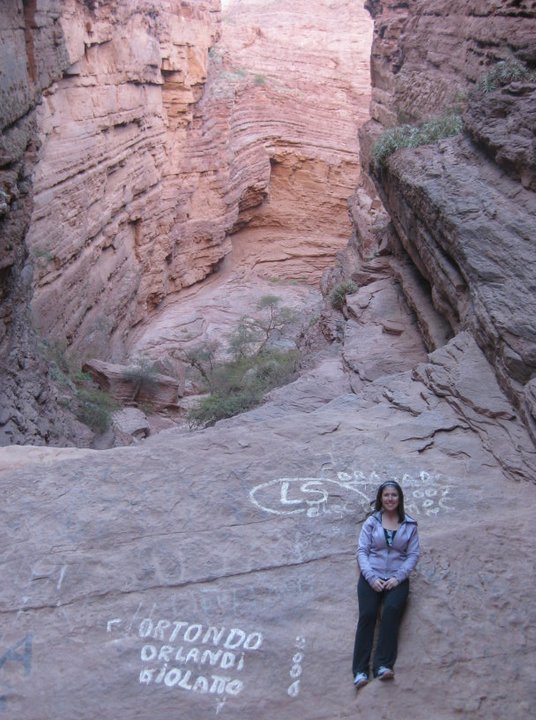
I´ve skipped over a few places, mainly Sucre and Copacabana, not because they weren´t worth mentioning but because my friend Melissa was traveling with me and I was spending less time on the computer and running around Bolivia with her for 3 weeks! Sucre was an okay town. It was very pretty, but the way I had heard it described I thought it was going to be amazing. When we got there, we realized there was very little to do. We went to a Jurassic Park-type place one day, where there was a giant stone slab that had dinosaurfiitprints that has been preserved since - well - the dinosaurs roamed the earth. It was a little cheesy but I thought it was interesting and we took some fun pictures with the giant dino replicas. The food was slightly better there than the rest of Bolivia (we found a place that had giant potato croquettes filled with spanish cheese and tomato sauce - delicious!) and there were lots of chocolate shops, but not nearly as good as Bariloche!
Copacabana was a really cute, relaxing town, but since it´s winter, the weather was awful. It got so cold at night that we had to wear THREE sweaters (I finally caved and bought another llama sweater, but in a giant size so it fit over all my other sweaters!) We met back up with Cassie & Kenzie and tasted delicious trout, which is Copa´s specialty. One day we tried to do a hike but were stopped by a tiny dog that seemed to not want We went to Isla del Sol and hiked around the island and saw the Incan ruins, The whole island was so beautiful and it was a great hike, of which I´ve returned with my 4th sunburn of the trip. No, I haven´t learned my lesson and my sunscreen is still untouched in my suitcase waiting for the beaches in Ecuador.
We had a little hiccup that altered all the plans in Copacabana. We were on the way back from Isla del Sol when the friends we made from California, who are here on a med school internship in La Paz, told us their program director had emailed them that they didn´t have to work the next day because there was a transit strike in La Paz and there was no way to get around. Well, we had to get to La Paz in the morning so Melissa could make her flight back home. We get back to the island at 5:30, go to the internet cafe to see if we can find anything out (the people at the buses will typically lie to you to get you to buy a ticket and not care if you actually reach your destination or not). No one seems to know about the strike, not even the Bolivian newspaper La Razon that I´ve gotten pretty good at translating. We walk up to the buses to find out what time we can leave in the morning, and the man tells us there are no buses tomorrow until 6:30 pm because of...the strike. Now it´s 5:50. The last bus out of Copa to La Paz is 6:30. Our stuff is all over the hostel (which we already paid for), so we have to RUN back to the hostel, THROW our stuff in our bags and run to the bus. We both are almost out of money, we have just enough to pay for the tickets and buy ´dinner´, which consists of Pringles and Twix since we can´t afford anything alse and have about 6 minutes to spare. We do make it back to La Paz successfully, and Melissa makes her plane and I hang out for the day until taking a bus to Cochabamba, which I was planning on skipping but have no choice now since I still can´t get to Peru quite yet. I´m going to take the long, 4 bus 2-day route on Friday to get to Arequipa, unless a miracle happens and I can get a flight for under $200 (they´re currently pricing around $500).
Oddly enough, I found my new favorite food in Bolivia that turns out to be a Dutch snack. Bitterballen, most common in the Netherlands and Belgium, are little balls of meat, beef broth, flour and spices served with a little bowl of mustard dipping sauce. There are a surprising number of Dutch places here, and I´ve had it 3 times and am kind of obsessed!
On to the last stop (sorry for skipping around, this entry has been in progress for over a week): Cochabamba. Now, I was going back and forth about coming here, and once I decided I´d had enough of Bolivia I was trying to get out and move along to Peru and the warmer weather, nicer scenery and less crowded streets that come along with the crossing of the border. However, that didn´t happen as I´ve been incessently complaining about, so I took an overnight bus to Cochabamba instead. This town is known for having the world´s largest statue of Christ (bigger than the one in Rio!), and that´s about it. But I heard there were also treks in the area around it, and it´s the paragliding capital on Bolivia, so either way it would give me something to do.
The one thing I didn´t realize was how much of a non-tourist town it was. I wanted to climb to the christ statue, but couldn´t because there´s danger of being robbed. I can´t walk anywhere past 9 pm, and I definitely heard gunshots from my room before.
That being said, the weather is great, they call it the City of Eternal Spring, and I´ve found better food here (corn and cheese hornitos!) than in most of the other places I´ve been. I did get to go paragliding, which was raelly cool although not as much of a rush as I was expecting. I guess after going bungee jumping and sky diving, biking death road and walking down the street in La Paz everything else can seem much tamer. It was really fun regardless, and I had a great view of the whole city. I spent 2 days wandering, retreating to my hotel (yes, I checked myself into a hotel. I even did a great job at negotiating the rate down to nearly half what they were charging, AND checking in at 6:30AM without paying for the extra night! I´m learning!), and the highlight of my time was finding a bracelet with Bolivia´s flag´s colors and a little icon of my boy Che. For only 3 Bs (that´s about 43 cents).
Paragliding was awesome. I´m glad that I waited to do it instead of going in Argentina where it was more than twice as expensive. Here it was $50, overlooked the giant Jesus statue and I loved every second of it. I´still have an awful fear of heights that wont go away despite doing things like sky diving and paragliding, but I will keep trying! This was a little different than jumping out of a plane, because when I went sky diving I was attached to someone who just pummelled us out of the aircraft. With this, I had to run with the guy until my feet weren´t touching the floor anymore. Then I sat down (the backpack has a seat in it!) and enjoyed the view. I begged him to do tricks, but he said that doing tricks makes you come down too fast so he just did a couple little turns to appease me. It will still cool and I´m SO happy I went.
My trip here was an even bigger success when I found out I could bypass going back to La Paz, and take a bus straight to Arica, Chile tomorrow to begin my journey to Peru. From there I spend a night, take a bus or train over the border to Tacna, Peru and continue to Arequipa, where I´ll be climbing into a canyon that´s twice as deep as the Grand Canyon. I´ve heard it´s amazing and I´m so excited to get to Peru and see for myself!! Fingers crossed I get over the border this time!
Lori and the Llama
Saturday, June 18, 2011
Monday, June 13, 2011
Hi Ho, Hi Ho, into the Potosi mines we go
When I was about 12 years old and my brother was around 6, my parents took us on vacation to California. I remember a lot of driving, a lot of complaining, because even though we were going to Disneyland and fun places, we were children and complaining is what children do best. My father decided it was a good idea to take us across the Mexican border to Tijuana, to show us what poverty was like so we could appreciate the vacation we were on and all that we had that came along with being a child from middle-class America.
All I remember from the trip over the border was annoying children surrounding us and begging us to buy chiclets, which I learned fairly recently was not chiclets but chicle, the Spanish word for gum. I didn't feel privileged at all, if anything I felt annoyed at my father for wasting a day of our trip to nearly get us robbed by pesky mexican children.
Today, the point my father was trying to get across to me finally happened.
Melissa and I took a trip 3 hours South from Sucre to a town called Potosi. Potosi is both the oldest town in Bolivia and the highest town in the world (4,070 meters above sea level), established in the 1600s when mines containing silver, zinc and other minerals were located. I'd been going back and forth about coming here, because while taking a mine tour is extremely interesting, I've been told how it's also extremely depressing, dirty, in a dark tiny tunnel (I am majorly chlostrophobic) and there's nothing else to do in the town besides the mine tour. We realized we had an extra day that could have been spent here or in Sucre, so we decided to get on the bus and give it a shot. The mines are located in a mountain called Cerro Rico, which is 4,824 meters above sea level, which is about 15,800 feet. That's not even a number!
I will start by saying this. It was the most depressing, interesting, eye-opening and slap in the face reality check I've ever had. The path into the mines is pitch black, short so you need to walk hunched over, with drastic temperature changes as you go into the depths of the mountain. You can't breathe at all. Aside from the lack of oxygen from the height, there is little air and a lot of chemicals inside. The men in the mines work 8-10 hours a day, 6 days a week, and make the equivalent of about $12 a day. The work they do is insanely hard. They take dynamite to blow up spots to dig for more materials. They load the minerals into primitive carts that weigh a ton, and then have to shove the carts down terrible tracks that the carts fall off of. Its more strenuous manual labor than I can describe, and the conditions are so bad that most miners die around the age of 45. All I could think about while I was down there was how insane the monetary scale is in comparison with everything I know. I mean, the millions of dollars I've helped spend on advertising while these people kill themselves a little more every day for tens of dollars. I feel like seeing what I did today really puts so many things for me in perspective, and makes me not want to care or complain about half of the things i do on a regular basis. Once we were outside, there were 3 stray dogs. Two were asleep on top of piles of garbage, the 3rd was scavenging through the trash for food. There was no food in sight, so the poor dog took comfort in playing with a dirty wad of cotton. This topped off what I'd just seen in the mines, and tears rolled down my face for all these poor people and defenseless animals who will never be in a better position in their lives, no matter what they do.
After we left the mines, we did of course have a few amusing occurrences to lighten the mood of our few hours in Potosi. First the engine died on the cab that was taking us to the bus station. The cab kinda glided it's way there since the streets were all downhill. Then we get into the bus station, where it's negative 10 degrees, and we have 3 hours to sit at a restaurant where we're surrounded by people howling like zombies on the floor below us the entire time. I felt like I entered the seventh layer of hell sitting there in that terminal. Although hell would have been way hotter than this. The bus ride was tolerable, but we arrived in La Paz to find it just as cold as the place we left, with a 2 hour wait for the bus (the earlier one doubled booked their seats and took off without us). While we were waiting for the bus i was interviewed by a Bolivian news station about the border crossing. I couldnt understand what he was asking me so i think i lied and told him we were going to Peru (we were not going to Peru). We ended up paying twice as much and then getting shepherded out of the bus station and two blocks away, to stand on the side of the road and wait for a makeshift van to cram us and our backpacks into a space that could accommodate about half the number of people and bags. A woman got on the bus to let us know that we might have trouble getting there because of border issues, and asked us for our email addresses in case of emergency. If our bus got attacked by rocks hurled by protestors I'm not sure where exactly I'd have email access, but we spent the next 4 hours looking for signs of trouble. Luckily, the only problem we had was when were told to get off the bus and the bus went on a raft across a lake and no one had any idea where we were crossing or why, but we all followed on a $0.30 ferry and continued on our way.
We made it to Copacabana, only to be rushed back to La Paz a day early due to yet ANOTHER Bolivan strike. Plans had to be shifted, and now I´m heading to Peru a few days later than planned. Instead I´m off to Cochabamba.
Saturday, June 11, 2011
Welcome to the Jungle
Next stop was Rurrenbaque in northern Bolivia, the jumping off point for tours to the jungle and pampas near Madidi National Park. This was easy to book, because our friend that had lived in La Paz had everything written out for us. Only downside was that the prices all DOUBLED 2 weeks ago, so the tour went from around $120 to about $250. But it was why it was, so we opted for the 1 hr flight on military airline over the 22 hour bus ride on an unpaved road and were off.
We landed on a field where there was no airport, and a line of men motorcycles surrounded by cows trying to bring you into town. Weirdest non airport ever. We knew we were in trouble when we got to the room and me and Melissa both freaked out over a tiny lizard sighting in the bathroom. The jungle was going to be an interesting experience!
In the morning we set off with 2 girls from South Africa, a couple from Ireland, and our Bolivian Tarzan boy guide Victor. After a 3 hour car ride and 2 hour boat ride (nothing is easy to get to in these places), we were there. It was such a cool, strange, dirty, mosquito-ridden experience. Our group all got along great which was awesome. Caiman (alligators) line the riverbank, along with these animals that look like giant guinea pigs, 6 foot tall birds, and monkeys dangling from the trees. It was amazing to see these animals in their natural habitats like this. We had no idea what we were going to come across next.
The lodge was kind of gross, we all slept in one room on dirty beds with our only protection being a mosquito net, but we were in the jungle and not at Animal Kingdom so I really couldn't expect too much in terms of hygiene. The first night we watched the sunset, and after dinner took a night boat ride to find more gators in the dark. They look so eerie at night with their heads sticking out of the water, watching you with eyes that glow orange by dark. When we got back to the lodge, I spotted snakes by the dock, which turned out to be cobras. I jumped out of the boat as fast as I could, despite our guide telling us that they aren't dangerous.
The next morning everyone was getting up at 6 for the sunrise, but I'd seen my share on the salt flats and early morning buses so opted out. Well, when I woke up after they all left to stampeding on the roof, beastly howls from the window and the fluting of wings INSIDE the room, I wished I had sucked it up and gone with them. Turns out the noises and footsteps were howler monkeys on the roof, and the fluttering was a bat that someone got inside. I was protected in my little white coffin of a mosquito net, which I'm surprised u ever got out of. Day 2's activities including anaconda hunting in swampland wearing raincoats since the mud came up to our knees in 100 degree humidity with thousands of mosquitoes attacking. I've never seen this many big bites in my life and the aftermath is not pretty or the least bit comfortable. And we found 0 anacondas. The night activity was more successful, piranha fishing, where nearly everyone caught one except me of course, and we even got to eat them for dinner although I'm pretty sure that it's illegal to eat piranhas. Our guide's mantra was "todo es possible", all is possible, so we went along with it. I only had one bite, there's very little meat on it but it tasted very similar to white fish.
Day 3 includes hanging around on hammocks, my favorite activity by far, making fun of the boatload of Japanese tourists who showed up on Day 2, and swimming with pink dolphins! We were all terrified to jump in the water since it was filled with piranhas and gators, but Victor swore all was possible and safe so in we went like dumb little tourists. The dolphins came pretty close and it was awesome to be that close to them without being in a giant pool in the Bahamas. We celebrated our return to Rurrenabaque by all going out for dinner and blue drinks at a bar, appropriately called Mosquito bar (not to be confused with Monkey Bar up the road). The jungle was an awesome experience, although to be back in a place without bugs, dirt and showers is much appreciated.
Tuesday, June 7, 2011
Bolivia - La Paz & the Death Road
After my experience in the salt flats, I decided I needed a few days in a big city to chill out for the first time this vacation before Melissa got here. I took an overnight bus from Uyuni and checked myself in to a private room with my OWN bathroom and TV in the room. Its crazy to imagine that just 2 months ago I had my own apartment in Manhattan and now I'm beyond excited to sleep in something that's not a bunkbed. I hadn't slept for days and was beyond exhausted when I got there, but I found SIX friends I've met along the way at breakfast! I explored the first day, revelled in the fact that everything in Bolivia costs under $10, and watched 100 episodes of 2 1/2 Men on my own private tv. On Sunday, I was reunited with my travel friends Cassie an Kenzie, and a few hours later Melissa arrived!
We all signed up to do the death road bike ride on Tuesday. Death Road is a 64 km downhill bikeride to Corioco on a narrow, steep dirt road with drop-offs that if you go over the edge, well... That's it for you. The road got it's name because there used to be more deaths on this road a year than any other in the world. The road used to have cars on it too, which meant more deaths, but now it's only open for the bike riders. We went with one of the reputable companies which are known for having good guides and equipment. If you have bad brakes, or no knee pads - there were a lot of things to decide before signing our lives away on the contract. The ride was the hardest and most incredible bike ride I've ever been on. The scenery was amazing. You start out at 4,700 meters above sea level, so the winding narrow road is above the clouds and in a layer of mist which made me feel like I was riding in Jurassic Park. We had a training ride on gravel for the first 30 minutes or so, and then went on to the main road. There were rocks everywhere that I knew if I landed on the wrong way I was going over. Me, Melissa and Kenzie decided to ride our breaks the whole way down because I was convinced if I had the tiniest bit of speed I was losing control of that bike.
We were the slowest ones, but had a personal escort, Oscar, who got us down after about 4 hours to safety. Web we got to the bottom we found out a girl that went with one of the junky companies had a bike whose breaks failed, and she fell over the edge and died. It was the first death on the road in about 2 years. Our friend Diana, who rode with a different group, also fell and cut open her chin and knocked out 2 of her front teeth and had to cut her trip short and flu back to Brazil to recover. At the end of the day, I'm so glad I did it because it was amazing, but I'm even more relieved that nothing bad happened to me or my friends I was there with (minus Diana of course).
In all in was in La Paz for almost 6 days, which is the longest amount of time I've spent in any city so far. It was a busy, crowded, dirty city with a lot of bright colors and poor people, which sounds terrible but I did really like it there. Not enough to want to go back, but I enjoyed my time there. Some of the things I found were interesting (plantains and fried chicken on every corner at night - replaces my drunken empanadas after a night out) and a market that was bigger than some towns in upstate New York that sold everything from sewing machines to cotton by the kilo to used clothing. And I finally did some shopping, and am now the proud owner of a Che Guavara t shirt and $0.40 bootleg DVDs!
Sunday, May 29, 2011
San Pedro de Atacama to Salar de Uyuni in a 4x4
The ride from Salta to San Pedro de Atacama, Chile was only 8 hours, but no one told me that we go on a road that brings us up to over 5,000 meters elevation. I couldn't figure out why I had a migraine the whole ride and couldn't lift my head more than an inch off of the pillow. We got to San Pedro, and I'm not sure what I was expecting but I felt like I was in a scene from a western movie from decades ago. The bus let us off in a dusty parking lot. There wasn't a bus station, and there was a main square but nowhere in my eyesight. Luckily I met Esther and David, who were staying in my hostel, and we found the place together. Minus the odd fact that the hostel owner had 7 cats running around the place, it was decent, with hot showers from 6 am-9pm, which seems to be all it takes to get me excited these days. My first night I went out to this place where a cool French astronomer shows you different stars, planets and constellations with these giant telescopes. It was amazing how clear you could see the sky from the middle of nowhere. When he was naming all the constellations, I couldn't figure out why I didn't recognize any of them but I realized it was because I live in the northern hemisphere, so the sky i see is actually beneath my feet here. Which made me feel sad and far from home. Luckily that night I met really nice people from my hostel, and we sat around by a fire and I felt less sad by the time I fell asleep.
Day 2 of San Pedro I had to cram in a thousand activities because I decided I wanted to go on the salt flat tour the following morning. There were enough activities to keep you busy at least a week, but the town is super expensive so I didn't want to spend too much time there. In the morning I went sand boarding. The day before my friend from the hostel said their group had 16 people and they shared the dunes with other groups. When I went it was me, a German girl and our pervy tour guide and that was it. It was really cool having the whole place by ourselves. My first couple of times down I was scared, but the sand hurt less than cold snow would on a snowboard, and since we were in the middle of cool rock formations in Death Valley I was too busy having fun to realize that i was actually pretty good. Of course I managed to split a hole in my leggings and thought my sandboarding days were over, but luckily the German girl had a spare pair and we finished our 3 hours of boarding on the dunes. I got back to town, rented a bike and set off to try to squeeze 2 days worth of site seeing into the 5 hours I had left until the sunset. I made it to the ruins in Pukara de Quitor, and then set off for the Moon Valley, which has more crazy rock formations that look like craters like you're on the moon.
I ran into my friend from Salta, and the group rode around the moon valley until it got close to sunset. I had been warned to hurry back before sunset because the roads got pitch black and it gets cold at night. I started rushing everyone, and of course on the way back it was super steep and rocky. My friend Sofja and I were in the middle of saying that we wishes we had worn helmets because this was really scary, and we turned a corner and saw that one of our friends Andrew was laying on the side of the road, off his bike covered in blood. We were in the middle of nowhere, about half an hour from the town and no way to get Andrew there. A tour guide found us and said he called an ambulance, but no ambulance ever showed up. Thank god a tour group was coming through to see the sunset at the valley, and they had a doctor on board who helped Andrew and the van brought him back to the hospital. Turns out he had to get stitches, surgery and his teeth replaced because he knocked them out. It was an awful experience and thank god he was okay. I swear I will always wear a helmet from now on. We raced back to town just as it got dark and made it back to safety to prep for our morning tour.
Our group, with the tour agency Atacama Connection, had 18 people in total, split up in 3 4x4s and 3 drivers. The guides all spoke Spanish , which was good for me to try to make sense of what he was saying. I had a really good group in the car and we got along amazingly for the 3 days. On the first day we stopped at a million lagunas, all different colors because of the minerals in the water. There was a white one, green and multi-colored lake that had flamingos living in it. It was all so beautiful, but the wind that day was insane so we had to keep running in and out of the car so we wouldn't get blown away. We had to get to the hostel early because driving through the desert, there aren't lights so we can only drive during daylight hours. The hostel was a few rooms made of big cement bricks with hay for a roof held down with rocks. Once the sun set, the temperature dropped to about 5 degrees below freezing. I literally thought I was going to die that night. I already lost my winter coat so I've been only wearing a wind breaker jacket and lulu hoodie, which was not enough to survive this cold. Combined with the fact that we were now eating Bolivian food and at an elevation of 4,900 meters, I felt like I was going to die. I took all of the extra blankets from the spare beds, took a sleeping pill and eventually stopped shaking enough to fall asleep.
In the morning it was just as cold, but as we set off and the sun came out it got more tolerable.
We went to see some rock formations that people say look like a Dali painting (I didn't see the resemblance), more lagunas and a volcano. We stopped in a village where we were able to buy beer made from quinoa and twix. I didn't realize how excited I would be to see American candy so far from home, but when you're this far removed from warmth and civilization, it's the little things that count. The 2nd night we slept in a hotel made of salt. The floor, the walls, the beds - the whole thing was SO cool. Unfortunately, no warmer. But for 10 Bolivianos, they gave you hot water for the shower. I think I spent more money on bathrooms and hot water than I did on food for these 3 days. We played travel scattegories (clutch purchase) until we were too cold to be awake, and froze to death for the second night in a row. This night I couldn't take a sleeping pill, because we had to be up at 6 for the sunrise, so I don't think I actually fell asleep that night.
On day 3, still cold, sleep deprived and suffering from altitude sickness, we set off for the salt flats. This was the whole reason for the journey, and it did not disappoint. The salt flat extends for 12,000 square miles. It's insane how you can look around for miles and only see blue sky above, salt below and nothing else but the other jeeps on our trip. We took the traditional salt flat pictures, which came out SO cool. I still don't understand how it works so luckily other people knew how to do it. After we played on the flats for a few hours, we headed off to Uyuni. About 10 minutes from our destination, the back tire on our jeep came flying off of the car and rolled away. Our car fell into a ditch, and we were completely stranded. Our tour guide was such a trooper and was able to fix the whole thing somehow, using flat stones to hold up the jack high enough to get the at lifted after we scoured the road for the missing bolts. By the time we got to Uyuni, I was now sick from the constant weather changes, altitude shifts, lack of sleep and now sunburn from sitting on the side of the road while our car was mended. I decided against spending the night in the town, or continuing to the mines in Potosi, because I needed recuperation time before Melissa gets here on Sunday. I splurged for the nicer bus, which meant I had heat and it didn't break down on the side of the road, and made it to La Paz in time to check in to my first private room and relax for the first time in weeks. The salt flats were an awesome experience, but definitely one of the most difficult things to survive.
Saturday, May 28, 2011
Directions, or lack thereof
The spanish word for left is izquerida.
The spanish word for right is derecha.
Now when someone tells you to go straight, the expression is ´sigue al derecho.´
I learned this from my Rosetta Stone during the directions lesson, and find of assumed that ´sigue al derecho´ meant ´follow to the right´, since sigue = follow and I couldn´t think of what else this could mean.
I was told that the word for straight is actually derecho. Now, why would you do this to me, spanish? Why would you make the word for straight and the word for right only one letter apart. A letter, no less, that usually determines if a word is masculine or feminine.
Now add that to the fact that people talk 4 times as fast as New Yorkers. I have accidentally gone to the right instead of straight and vice versa more times than I would like to admit.
Aside from the language barrier, there are signs. Sometimes you will be looking for something, for example, a nature reserve as I was today. I see no signs anywhere identifying where said reserve may be. So I stumble across a sign with a picture of what I think might be a penguin. Now, no, I don´t think to question why on earth there would be a penguin in Northwest Argentina on a day that´s 70 degrees. But there´s no other sign, so I follow the arrow. And end up at a church. The ´penguin´was actually a nun. Oops.
I think that´s still better than my experience looking for the zoo in Budapest last summer. I took a bus 45 minutes to where this major zoo was supposed to be. When I get off the bus at the stop the driver told me to, I see nothing. I start walking down this trail that looks like it leads to nowhere, for about 30 minutes. When I get towards the end of the trail, I see a picture of a bumblebee with an arrow. I don´t know if that means ´this way to the zoo´, or bumbleebees, this way!´ Since I don´t think bees are a popular zoo attraction, and I am not a bumblebee, I was pretty sure I should run the opposite direction. But there was no other way to go, so I pretended I was a bee and went the way the arrow pointed. Eventually I did find the zoo (where there were no bumbleebees to be found), but that sign always amazed me.
Friday, May 27, 2011
Last stop in Argentina - Salta
After another 22 hour bus ride from Iguazu, I arrived bright and early in my last stop in Argentina, Salta. Over the past 7 weeks I´ve been popping around between Argentina and Chile, but in total I was only in Chile for 9 days, and the rest was in Argentina. It´s been amazing, but I would be lying if I said I wasn´t excited to move on to a new country.
Salta is in the NW of Argentina. It´s a smallish town which is most known for it´s proximity to a lot of the smaller towns in NW Argentina, like Jujuy and Cafayate. There are some beautiful colorful churches, and a mountain (San Bernardo) that you can climb up, similar to San Cristobal in Santiago, to get a view of the city. On my first day, I set off to the mountain and climbed the 1,070 steps to the top. Since I´m neurotic I spent the whole way up counting the steps to see if they were accurate (Becca, didn´t we do this at that church in Venice?) I´m not sure if I miscounted or they miscounted or maybe numbers are different in spanish, but I got to 1,088.
After that I found a mall, which would be exciting if I wasn´t still banned from buying things.
When I went back into town I went to this museum called MAAM (Museo de Arqueologia de Alta Montana). In 1999 these 3 Incan children´s bodies were found on top of Llullaillaco volcano, preserved from they think the 1500s. The volcano is at 6,739 meters above sea level. To give you a comparison, Potosi in Bolivia is the highest city in the world, at 4,090 meters. Cuzco, which they tell you you need 2 days to acclimate to the high elevation, is at about 3,500. So this volcano is really high, and was able to preserve the children because of the low atmospheric pressure, low humidity, and low termperature. They think the Incan children were used as sacrifices, and this museum recreated the conditions they were found in so you actually see one of the children. When I went the boy was on display (7 years old). The other two children are a 6 year old and 15 year old girls. It was really creepy and I was only able to stay for a couple minutes because I felt like the boy was going to open up his eyes and look up at me. There was a market 45 minutes outside of the town that I ventured out to, but by this point I´ve already decided I was waiting until I got to Bolivia to buy anything so it was more just for something to do.
On my second day, I took another ridiculously long bus trip to go to Cafayate. After the 40+ hours roundtrip to go to Iguazu I don´t know what possessed me to get on a bus, but I did. 3.5 hours each way to go to a town called Cafayate. It was a beautiful bus trip (the part I was able to stay awake for was, anyway.) The mountains adoring the road are all pink and have canyons in them made by water. When we got to the town it was really small, which was consoling because I had thought about spending time in these smaller towns but realized I would have been bored out of my mind. It was good for a few hours - wine tour in spanish, lunch, chocolate, pictures and back on the bus. On the way back the guide surprised us and pulled over so we could feed llamas! There was a baby one there and I was, of course, ecstatic. Right next to the llamas they were selling different kinds of salami, including llama salami, which I thought was just wrong. I´m not vegetarian anymore but, I mean, I won´t eat a cow either if he´s standing right next to me watching me dig into his brother with a fork and knife!
Back at the hostel I ended up in a deep conversation with my dorm about this end of the world nonsense. Turns out everyone there was an athiest, which turned into a bigger discussion about religion, which I felt uncomfortable being involved in because the truth is, I don´t know that much about it. I am a Jew by birth, but a non-practicing one. I had a brief stint after Israel where I felt closer to having some sort of religion again, but I didn´t carry on any traditions which I think put me back at square one. For a while I considered myself agnostic, belief in a god but unaffiliated with a particular religion, but after my aunt Rhona died I was kind of lost again, because if there was a god how and why would he take someone as amazing as her? I don´t want to say I´m athiest either, though, because I do believe we all came from somewhere, and maybe it is through evolution and the bible is just a story but that brings me back to my original statement - this conversation makes me uncomfortable because I really just don´t know enough to have a firm opinion on the matter. I am going to read Richard Dawkin´s book The God Delusion, which has been on my Amazon wish list for a while now, and maybe then I can participate more in the next conversation. It´s 4:17 pm here so if the world does indeed end in an hour and 43 minutes, this will be a moot point anyway.
On my last day I took a bus to a neighboring town, San Lorenzo. There´s a nature reserve where you can go hiking, so yet again I ventured out of Salta to do another excursion. The bus ride was relatively smooth, minus not having coins to pay (who knew). A nice man swiped me with his card and didn´t even take my 2 pesos. I saved 50 whole cents! Sweet! When I got there, after getting mildly lost trying to follow signs, I find the reserve. There are 4 employees there to check me in. When they sign me in the book, I see that there are 3 names before me, all from yesterday. The last person had checked in at 10:30 am. This was now around 11am, so I was the first, and most likely ONLY person going there for the day. Why they need 4 people on staff baffled me, since my admission price was only $4. Hopefully more people came after I left but I was there about 2 hours and didn´t see a trace of another human being. The walk was pretty, with a million more butterflies. Nothing else really to see, but I think I got spoiled after all of the amazing hikes in Patagonia. I realized I had completely managed to do this entire city in less than 2 days, so spent the remainder of my day wandering around, getting my last tastes of Argentinean food (bye bye Freddo ice cream and dulce de leche!)
After my 7 weeks here, I can say, these are my favorite things about Argentina & Chile:
Town: Bariloche
Activity: Toss-up between the Perito Moreno glacier and Iguazu falls.
Restaurant: La Cabrera in Buenos Aires. Hands down.
Ice cream: Anything from Rapa Nui in Bariloche
Chocolate: Dulce de leche chocolate covered bon bons from Cachafaz
Drink: terramoto
Best hostel: I think the Che Legarto in El Calafate. Decent location, good breakfast, and a shower IN my room. That never happens!
Bus company (and yes there were many): Expresso Singer
Worst part of my trip so far: Toss-up between having to get passport pages added due to 6 exit and re-entry stamps into Argentina, and almost getting robbed at the Retiro station in BA
After Salta I head out tomorrow morning (7am bus. Awful!) to San Pedro de Atacama, to do some sanddune surfing and see the Valley of the Moon. Just a few days, then into the salt flats in Bolivia!!
Subscribe to:
Posts (Atom)